How Much Does It Cost to Finish a Basement in DuPage County in 2026?

Finishing a basement in DuPage County typically costs $50,000 to $75,000 for a straightforward finish, and $80,000 to $120,000 or more once you add a bathroom, wet bar, or home theater. The final number depends less on square footage than on what's going on underneath it: moisture, plumbing, egress, and how much the space needs to do.

Below, we'll break down each of those cost factors, explain why moisture and radon matter so much in our area, cover why winter is a great time to start, and share how to keep your budget under control.

Table of Contents

  • How Much Does It Cost to Finish a Basement in DuPage County?

  • What Drives the Cost to Finish a Basement in DuPage County?

  • Why Does Moisture Control Affect the Cost to Finish a Basement in DuPage County?

  • Is Winter a Good Time to Finish a Basement in DuPage County?

  • How Can You Keep the Cost to Finish a Basement in DuPage County Under Control?

  • Why Do Western Suburbs Homeowners Trust Rosewood Signature Homes?

  • Plan Your Basement Before Spring Gets Busy

How Much Does It Cost to Finish a Basement in DuPage County?

Most DuPage County basement projects fall into three tiers:

Basement Project

Typical 2026 Range

Straightforward finish (framing, insulation, drywall, flooring, lighting)

$50,000 – $75,000

Finish plus a full bathroom or wet bar

$80,000 – $100,000

Full entertainment level (bathroom, bar, theater, or guest suite)

$100,000 – $120,000+

If you've seen lower numbers online, you're not imagining it. Angi lists the average Chicago-area basement remodel at around $23,000. That number usually describes a smaller, simpler job, like flooring and paint in a basement that's already dry and wired. Most unfinished basements in the western suburbs need a lot more than that before they're truly livable, and labor rates here run above the national average.

For the full breakdown of renovation costs across every room, see our guide to How Much Does a Home Renovation Cost in Chicago? (2026 Western Suburbs Guide).

What Drives the Cost to Finish a Basement in DuPage County?

Six things move the number more than anything else. Think of them as the ingredients in your basement's price tag.

Size and Layout

More square feet means more framing, drywall, and flooring. But layout matters too. An open family room costs less per square foot than the same space split into a bedroom, office, and bathroom, because every wall, door, and outlet adds labor.

Bathrooms and Below-Grade Plumbing

A basement bathroom is the single biggest add-on, often $10,000 to $25,000 on its own. The reason is gravity. Upstairs, waste flows downhill to the sewer line. In many basements, the bathroom sits below that line, so it needs an ejector pit, which works like a sump pump for waste and pushes it up and out. That means breaking up concrete, installing the pump, and running new lines.

Egress Windows for Bedrooms

If you want a basement bedroom, code requires an egress window, a window big enough for someone to climb out of in an emergency. Adding one usually costs $3,000 to $7,000, since it involves cutting the foundation wall, digging outside, and installing a window well.

Ceilings, HVAC, and Electrical

Basements are full of ductwork, pipes, and wiring hanging from the ceiling. Working around them, extending heating and cooling to the new space, and adding outlets and lighting all add cost. Most codes also require a minimum ceiling height for living space, usually around seven feet, which can affect how low ducts and soffits can go.

Specialty Spaces

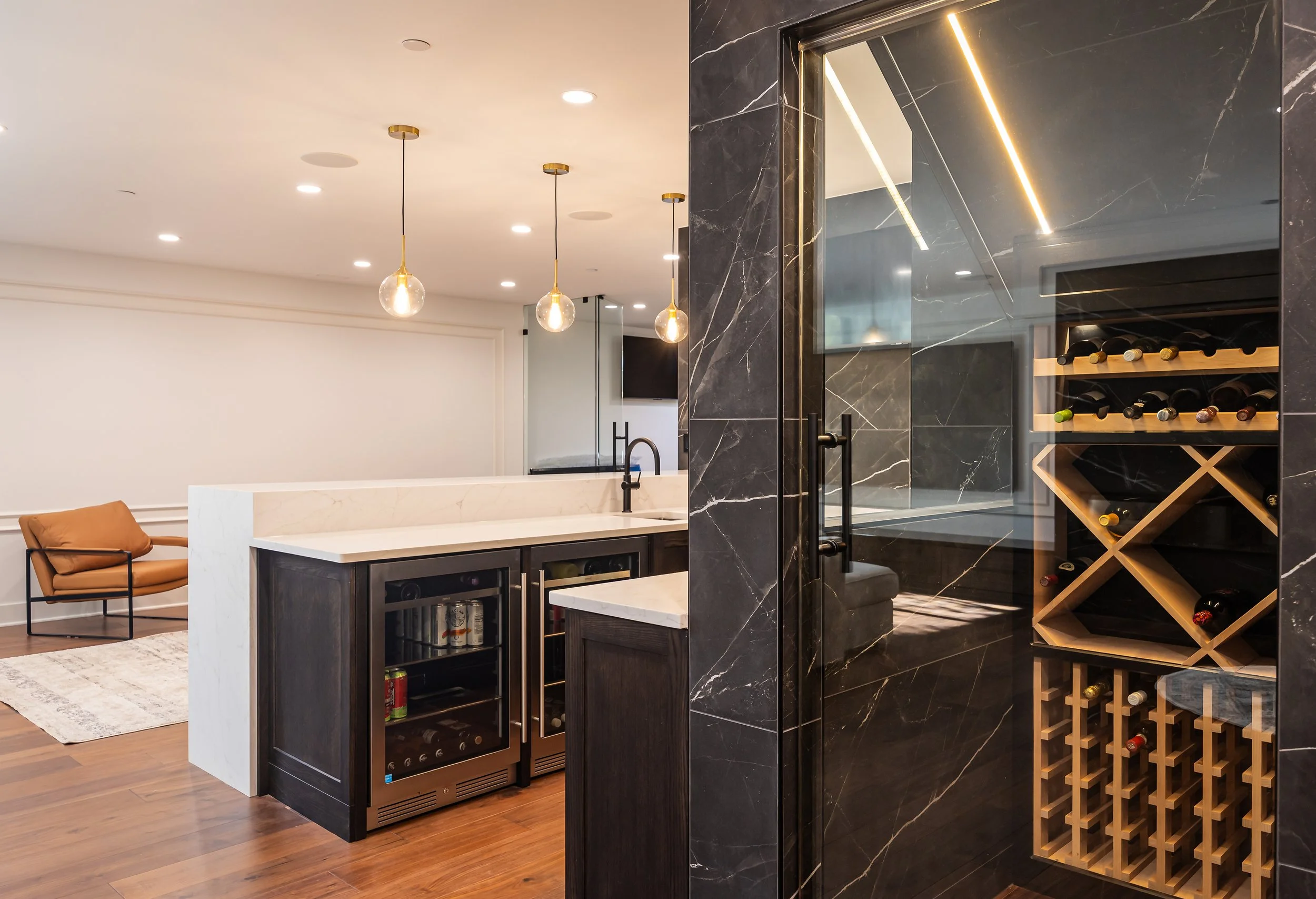
Bars, wine storage, and home theaters are where basements get fun, and where budgets grow. Custom millwork, under-counter refrigeration, climate control for wine, and sound control for a theater each add their own line items.

Permits

Basement finishing in DuPage County requires permits for framing, electrical, and plumbing work. HGTV, citing HomeAdvisor data, puts typical basement permit costs at $1,200 to $2,000, and inspections add time to the schedule. A contractor who builds both into the plan from day one avoids surprises later.

Why Does Moisture Control Affect the Cost to Finish a Basement in DuPage County?

Moisture control has to happen before anything else, because finishing over a damp basement means tearing it all out later.

DuPage County basements deal with clay-heavy soil that holds water against foundation walls, plus freeze-thaw cycles that open small cracks over time. That water has to go somewhere, and often it's into your basement. Depending on what we find, moisture work can include sealing cracks, upgrading the sump pump, adding interior drain tile, or installing a vapor barrier. If your basement is damp, budget roughly $5 to $10 per square foot for waterproofing across the full space before finish work starts.

Don't Forget Radon

Radon is an invisible, odorless gas that comes up from the soil. According to the Illinois Department of Public Health, 41% of Illinois homes tested had radon levels above the recommended action level. Radon can enter through foundation cracks and sump pits, which is why basements are where it builds up most. Since you're about to spend more time down there, test before you finish. If levels are high, a mitigation system is much easier to install before the walls and ceiling go up.

Is Winter a Good Time to Finish a Basement in DuPage County?

Yes. Winter is one of the best times to finish a basement, because it's an indoor project that snow and cold can't slow down.

There's also a planning advantage. Design, selections, and permits take time. Starting that process now means construction can wrap up by spring or summer, so your new space is ready for graduation parties, summer movie nights, or next year's holidays instead of still being on the to-do list.

How Can You Keep the Cost to Finish a Basement in DuPage County Under Control?

The best way to control your basement budget is to make your decisions before construction starts.

Set aside 10% to 15% for surprises. In older western suburbs homes, it's common to find outdated wiring or plumbing once walls open up. A contingency turns those discoveries into a line item instead of a crisis.

Choose finishes during design. Picking flooring, fixtures, and lighting up front keeps the build moving and avoids costly changes mid-project. For basements, luxury vinyl plank is a popular pick because it handles moisture better than carpet or hardwood.

Phase it if you need to. If a bathroom isn't in this year's budget, ask about roughing in the plumbing now. That way, adding it later is much simpler and cheaper.

For more on planning a renovation the right way, see our guide to [How to Renovate Your Home Without the Stress (Chicago Homeowners Guide)].

Why Do Western Suburbs Homeowners Trust Rosewood Signature Homes?

Homeowners trust Rosewood because we design and build basements around how their family actually lives.

Founder Mike Coomer started Rosewood with a simple belief: your family should be able to live in your dream home, even if that means getting there one room at a time. Based in Darien, we've finished basements across the western suburbs, from a full kitchen, dining room, and basement renovation in Glen Ellyn to a custom basement dry bar. Because we handle both design and construction, moisture, radon, plumbing, and egress get addressed in the plan before they become surprises on the job site.

Plan Your Basement Before Spring Gets Busy

You now know what it really costs to finish a basement in DuPage County, what drives that number up or down, and why moisture and radon come first. That puts you in a great spot to set a realistic budget and start planning a space your family will actually use.

If you want a real number for your basement instead of a range, our free consultation is the best next step. Mike will walk your basement with you, check for moisture and other issues that could affect the build, and talk through how you want to use the space, whether that's a family room, a guest suite, or a bar for game nights. From there, you'll get a clear picture of what your basement could become and what it would take to get there, with no pressure to commit.

Start Planning Your Basement With Rosewood Signature Homes

Or call Mike directly at (630) 913-4074.

How Much Does a Home Renovation Cost in Chicago? (2026 Western Suburbs Guide)

If you've been Googling home renovation costs and finding numbers that seem too good to be true for your area, they probably are.

National cost guides cite averages from markets across the country. Chicago's western suburbs — Downers Grove, Hinsdale, Naperville, Elmhurst, Glen Ellyn, Wheaton — are not an average market. Labor rates here run above national benchmarks, permit processes through DuPage County and surrounding municipalities add cost and time that other regions don't have, and the homes themselves — many built in the mid-20th century with older infrastructure — regularly reveal expensive surprises once renovation work begins.

Here's what home renovations actually cost in the Chicago western suburbs in 2026.

Table of Contents:

  • Why Western Suburbs Costs Run Higher Than the National Average

  • What Drives the Final Number in the Western Suburbs

  • Home Renovation Costs by Project Type (Western Suburbs, 2026)

  • Pro Tip: What Smart Homeowners Do With These Costs In Mind

Why Western Suburbs Costs Run Higher Than the National Average

Before the numbers, it's worth understanding why.

  • General contractors in DuPage County charge $90–$115 per hour. 

  • Plumbers run $105–$135 per hour. Electricians run $95–$125 per hour. 

  • Cabinet installers run $105–$135 per hour. 

Every one of these rates exceeds the national average for the same trade. Sometimes significantly.

It reflects the cost of living in the western suburbs, Illinois licensing requirements, and the sustained demand for skilled trades in a market where more homeowners want renovations than there are qualified contractors to do them.

Cosmetic remodels in the Chicago area run $50–$250 per square foot, while more complex remodels involving structural updates run $200–$400 per square foot. Factor in that labor rates in the western suburbs run above the broader Chicago metro, and the western suburbs consistently land at the higher end of those ranges.

Plan accordingly. A national cost guide that says a kitchen remodel averages $35,000 is describing a different city.

What Drives the Final Number in the Western Suburbs

Older home infrastructure. Many western suburbs homes were built in the 1950s–1980s. Once renovation work begins, it's common to find electrical systems that don't meet current Illinois code, plumbing that needs to be updated, or insulation that falls well short of current standards. These aren't contractor surprises — they're the reality of renovating older homes, and they need to be budgeted for.

DuPage County permit requirements. Most renovation work involving electrical, plumbing, or structural changes requires permits in the western suburbs. Permit fees are manageable, but the inspection schedule adds 2–4 weeks to most projects. A contractor who builds permitting into the timeline from day one is one who's actually planned the job.

Material tariffs in 2026. Import tariffs at 25%+ on European and Asian cabinet brands add $3,000–$10,000 to a whole-home renovation budget compared to 2023. For projects with cabinetry in kitchen, bathrooms, laundry, and built-ins, tariff exposure on imported brands can exceed $12,000. Specifying domestic cabinet brands avoids this exposure entirely.

Finish level. Two renovations of identical scope can cost dramatically different amounts based entirely on material selections. Knowing which finishes you want before design begins — and being honest about what you're willing to invest in each — is the most effective way to control the final number.

Home Renovation Costs by Project Type (Western Suburbs, 2026)

Kitchen Renovation 

$22,000 to $150,000+

The kitchen is the most expensive room to renovate in the western suburbs — and the one with the most variability.

A cosmetic refresh with new cabinets, countertops, and flooring but no layout changes typically runs $22,000–$45,000. A mid-range renovation with layout modifications, custom cabinetry, and upgraded appliances falls between $40,000–$85,000. A full gut renovation with structural changes, professional-grade appliances, and premium finishes in communities like Hinsdale or Oak Brook can reach $85,000–$150,000 or more.

What moves a kitchen renovation to the higher end: layout changes that require moving plumbing or electrical, custom cabinetry versus stock or semi-custom, premium appliances, and the finish level of every surface in the room. Two kitchens of identical square footage can differ by $50,000+ based entirely on specification.

Bathroom Renovation

$30,000 to $130,000

A full bathroom remodel in the northern and western Chicago suburbs can cost $30,000–$130,000 depending on size and scope.

A focused guest bathroom refresh — new tile, vanity, fixtures, and lighting without moving plumbing — lands toward the lower end of that range. A primary bathroom transformation with a custom walk-in shower, freestanding soaking tub, double vanity, and premium finishes throughout pushes toward the upper end.

Primary bathrooms in the western suburbs are where homeowners consistently see the most dramatic quality-of-life improvement from renovation dollars — and where Rosewood's design-build approach makes the most difference.

Basement Finishing

$50,000 to $120,000+

A finished basement in the western suburbs adds significant livable square footage and meaningfully increases a home's value — but the cost reflects both the scope and the specific challenges of basement construction in Illinois.

A straightforward basement finish — framing, insulation, drywall, flooring, and lighting — runs $50,000–$75,000 for a typical western suburbs home. Add a full bathroom, a wet bar, or a home theater, and the number moves to $80,000–$120,000+.

One important consideration specific to this region: moisture management in western suburbs basements is not optional. Illinois's clay-heavy soil and seasonal freeze-thaw cycles create moisture dynamics that need to be addressed before finishing begins. A contractor who doesn't assess and address moisture conditions upfront is setting you up for expensive problems later.

Home Additions

$150,000 to $400,000+

Home additions — adding square footage that doesn't currently exist — are the most significant renovation scope available and require the most planning. A new bedroom, an expanded kitchen, a mudroom, a sunroom — additions can transform a home's livability without the disruption and cost of moving.

In the western suburbs, additions typically run $150–$400 per square foot for finished space, putting most projects in the $150,000–$400,000 range depending on size, structural requirements, and finish level.

Permit timelines for additions in DuPage County and surrounding municipalities add 4–8 weeks to project timelines compared to simpler renovation scopes. A builder who accounts for this from day one keeps the project on schedule. One who doesn't creates surprises mid-project.

Specialty Spaces (Bars, Cellars, Media Rooms)

$20,000 to $75,000+

Custom home bars, wine cellars, home theaters, and other specialty spaces vary enormously based on the level of customization, the technical requirements (climate control for cellars, acoustics for media rooms), and the finish quality.

A well-appointed home bar with custom millwork, a back bar, under-counter refrigeration, and tile work typically runs $20,000–$40,000. A dedicated wine cellar with engineered climate control and custom racking runs $30,000–$75,000+. These numbers reflect the craftsmanship and specialized knowledge these spaces require — which is exactly why they're some of the most satisfying projects Rosewood builds.

Whole-Home Renovation

$150,000 to $400,000+

When multiple rooms and systems are addressed in a single project — kitchens, bathrooms, basement, living spaces, and mechanical updates — the scope becomes a whole-home renovation.

In the Chicagoland area, the average whole-house renovation of a single-family 3,300 square foot home runs approximately $235,000 when completed by a professional. In the western suburbs, where labor rates and finish expectations both run higher than the broader metro, $250,000–$400,000 is a realistic range for a comprehensive whole-home project.

The advantage of tackling multiple rooms simultaneously: mobilization costs are shared, trades coordinate across the full project rather than making multiple trips, and the result is a home that feels cohesive rather than updated in pieces over many years.

Pro Tip: What Smart Homeowners Do With These Costs In Mind

We call this the Contingency Rule: In any renovation, the standard advice is to add 10–15% to your budget as a contingency. In the western suburbs, where homes are older and surprises are more common, this is less a nice-to-have and more a basic requirement.

The contingency isn't money you expect to spend. It's money you have available if you need it — so that when the discovery behind the bathroom wall turns out to be outdated plumbing, it's a manageable line item rather than a financial crisis.

Budget for it upfront. If you don't need it, you have it left over. If you do — and in older western suburbs homes, you very likely will — you're covered.

Know Your Number Before You Start

The most useful thing you can do before talking to any contractor is arrive with a clear budget in mind — not a vague range, but a number you're actually comfortable committing to, built with a realistic contingency, and informed by what projects in your area actually cost.

When you want to get a feel for how much your project could cost, give us a call or send us a message below, and we’ll reach out to you with more details!

Start Planning Your Renovation With Rosewood Signature Homes →

Or call Mike directly: (630) 913-4074